
TAROT
Home > Tarot
TAROT READING:-
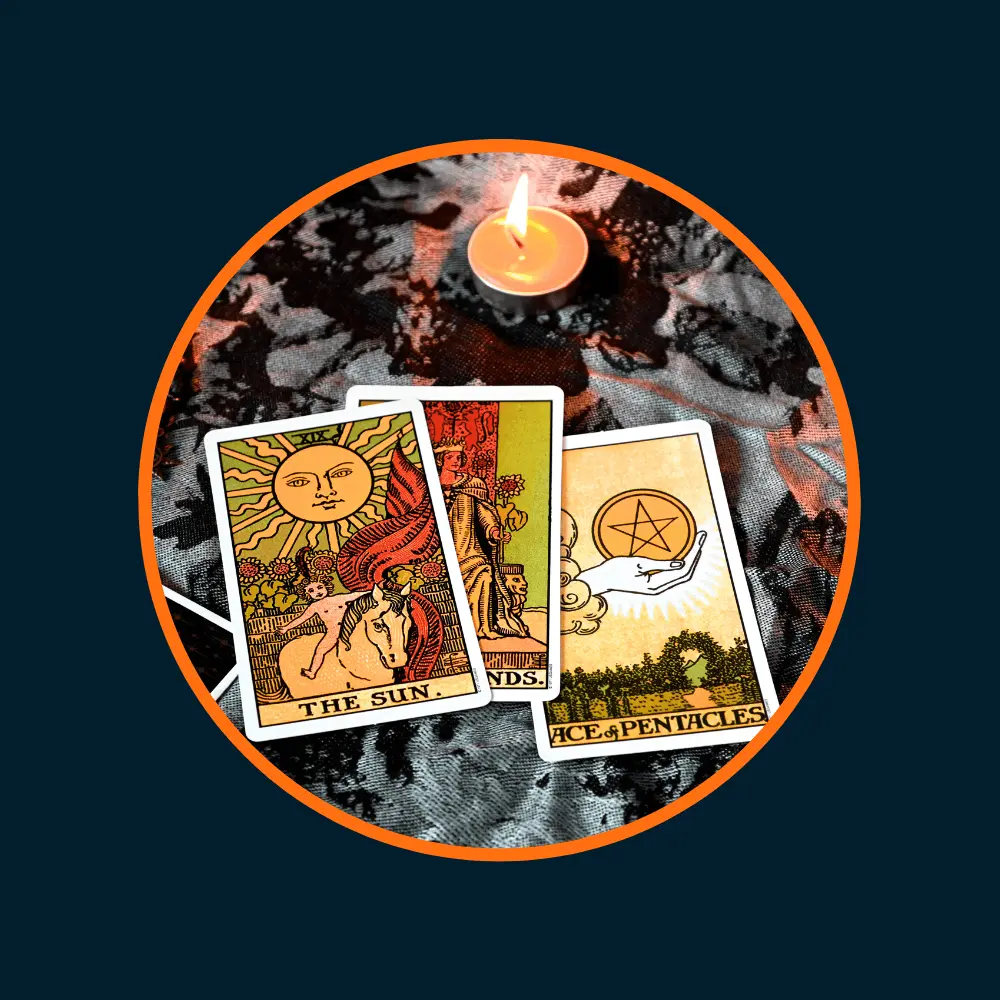
The tarot (also known as tarocchi, tarock or similar names) is typically a set of seventy-eight cards, composed of twenty-one trump cards, one Fool, and four suits of fourteen cards each—ten pip and four face cards (one more face card per suit than in Anglo-American playing cards)Tarot cards are utilized primarily for divinatory purposes, with the trump cards plus the Fool card making up the twenty-two major arcana cards and the pip and four face cards the fifty-six minor arcana.
The terms Major Arcana and Minor Arcana are used in occult tarot and are seldom used by card players.
The divinatory meanings of the cards are derived mostly from the Kabbalah of Jewish mysticism and from Medieval Alchemy.
Etymology:-
The English and French word tarot (or tarocchi, tarô, tarock, tarok etc. in other languages) does not have a precise origin — nobody knows its true etymology. Some people believe it comes from the Arabic word turuq, which means "four pathways", or maybe from the Arabic tarach, "reject". According to the French etymology, tarot is borrowed from the Italian tarocco, derived from tara: "devaluation of a merchandise; deduction, the act of deducting".
Common card interpretations:-
Each card has a variety of symbolic meanings that have evolved over the years. The many of the interpretations bear striking similarity to philosophy found in the Kabbalah or in Alchemy. Custom or themed tarot decks exist which have even more specific symbolism, although these are more prevalent in the English-speaking world. These are frequently created by amateur philologists who believe that they have a new insight into the proper analysis of the texts of Kabbalah and Alchemy. The literature specifies elements which must be present in each card for the deck to be proper Tarot. Artists are free to represent these elements in any they choose, and they usually try to draw the picture in such a way as to reveal a new truth. One example of how detailed they can get is the Major Arcana card The Moon. This card has several elements including a crawfish (or lobster), which is usually drawn very small, but is rarely omitted. Each card has several meanings, and the reader determines which meaning to apply based on the card's location in the spread and which cards are turned up around it. Common sense is also used to discard meanings which have no relevance to the question asked.
Minor Arcana:-
The Minor Arcana closely match Anglo-American playing cards, having Ace-through-Ten and four face cards. The face cards are Page, Knight, Queen, and King. Each suit of the Minors corresponds to one of the four Alchemical Elements. Pentagrams corresponds with Earth, Swords with Air, Wands with Fire and Cups with water. The Face cards also correspond to the Elements. The Page is Earth, the Knight is Air, the Queen is Water, and the King is Fire. This makes the Page of Pentagrams, the Knight of Swords, the Queen of Cups and the King of wands very strong cards.
The Suit of Wands
Ace · Two · Three · Four · Five · Six · Seven · Eight · Nine · Ten · Page · Knight · Queen · King
The Suit of Cups
Ace · Two · Three · Four · Five · Six · Seven · Eight · Nine · Ten · Page · Knight · Queen · King
The Suit of Swords
Ace · Two · Three · Four · Five · Six · Seven · Eight · Nine · Ten · Page · Knight · Queen · King
The Suit of Coins
Ace · Two · Three · Four · Five · Six · Seven · Eight · Nine · Ten · Page · Knight · Queen · King
Minor Arcana:-
The Major Arcana are a set of twenty-two cards, numbered zero to twenty-one, with no suit. There are usually many more elements in the images specified by the literature for this set of cards. These cards are often interpreted as describing the normal progression of a truly holy life, and often tell where a person is along their journey, or if they have strayed. Such an interpretation is called the "Fool's Journey" and it originated with Eden Gray
- (The Fool) · I (The Magician) · II (The High Priestess) · III (The Empress) · IV (The Emperor) · V (The Hierophant) · VI (The Lovers) · VII (The Chariot) · VIII (Strength) · IX (The Hermit) · X (Wheel of Fortune)
XI (Justice) · XII (The Hanged Man) · XIII (Death) · XIV (Temperance) · XV (The Devil) · XVI (The Tower) · XVII (The Star) · XVIII (The Moon) · XIX (The Sun) · XX (Judgement) · XXI (The World)
Spreads
To perform a Tarot reading, the Tarot deck is typically shuffled by either the subject or a third-party reader, and is laid out in one of a variety of patterns, often called "spreads". They are then interpreted by the reader or a third-party performing the reading for the subject. These might include the subject's thoughts and desires (known or unknown) or past, present, and future events. Generally, each position in the spread is assigned a number, and the cards are turned over in that sequence, with each card being contemplated/interpreted before moving to the next. Each position is also associated with an interpretation, which indicates what aspect of the question the card in that position is referring to.
Sometimes, rather than being dealt randomly, the initial card in a spread is intentionally chosen to represent the querent or the question being asked. This card is called the significator.
Kundali Patrika
Mangala Dosha
yoga
ABOUT US
Indian Astrology is considered to be one of the oldest, most accurate and consistent form of astrology all over the world.
USA OFFICE
- Tel : 001-425-472-7262
- 14705 NE 37th Place Apt B 25, Bellevue, Seattle Washington 98007
CANADA OFFICE
- Deveshverm Sikander
- Tel : 001-778-384-1579
- Nikhil Chopra
- 001-778-522-1072
INDIA OFFICE
- Tel : +91 84278-01008, +91 98150-28953
- Visit Us First Floor, Sant Cinema Market, old Railway Road-Jalandhar City Punjab
- swami_sikander2003@yahoo.co.uk
- www.swamisikanderji.com
© Copyright 2025 by swamisikanderji.com. All right Reserved – Design By Sriraj 91151-67956